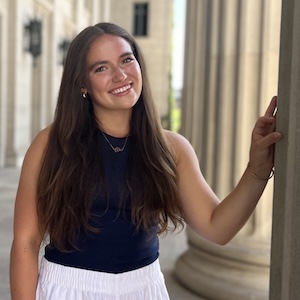
“I knew I was going to be in healthcare eventually, but I just didn't know what path to take to get there,” says Kate Sabling. “So I looked into (the Health and Wellbeing Sciences major), and I realized that it was exactly what I was looking for.”
What really appealed to her was how well it would prepare her for a physician assistant program while also giving her a “broader perspective of health.” Kate studied “not just anatomy, physiology, and the biological perspectives, but also how culture, behavior and environment affect health,” which she found complemented her approach to patient care.
Seeing the Bigger Picture
Kate’s interest in healthcare can be traced back to high school, when she took a physiology class through the University of Minnesota’s College in the Schools program. She remembers being fascinated by the small animal dissections. Soon after, she began to consider a career in medicine.
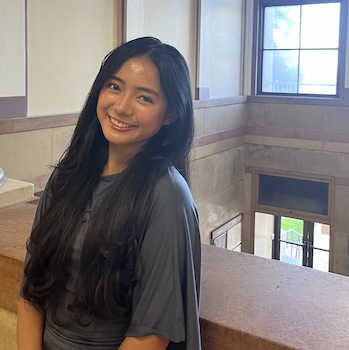
In college, when she observed dissections in the human cadaver lab, she grew even more fascinated by the medical field and surgery in particular. Instead of feeling squeamish, Kate experienced a deep appreciation for the human donors and a respect for the cycle of life.
Meanwhile, she shadowed physician assistants and was struck by “the way they adapted to patients and emotionally connected with them.” She realized how important it is to be able to relate to and communicate with different types of people in order to deliver the best care.
Those shadowing experiences drew her attention to how societal factors directly impact people's health and influenced her desire to work where she may be needed most. Kate remembers a particular time during a bad snowstorm at a community health center, where some of the patients couldn't reach the clinic because of transportation issues. The fact that “not everyone has the privilege to be able to just drive to their appointments” stuck with her.
Poised to Take the Next Step
Currently, Kate is a medical assistant in a dermatology clinic, where she directly assists a Mohs surgeon, a physician who performs a specialized type of surgery to treat skin cancer. “It's a lot of hands-on work, which I really love,” she says. “This is the first time that I'm working with a provider, so it's good exposure to the field of healthcare.”
She hopes to work in surgery someday, although she hasn’t settled on a specialty. But, Kate says, PAs have the flexibility to move between specialties throughout their careers. “I'm interested in everything,” she adds. “Musculoskeletal system was my favorite unit back in the anatomy cadaver lab, so that sparked my interest in ortho surgery, but honestly, any specialty is amazing. You can always find something that keeps you learning.”
Kate recently applied to PA programs and is now awaiting decisions. She plans to continue working at the dermatology clinic for a year to save money. With a mother who is a nurse and a brother who is a dental hygienist, Kate knows that the journey can be challenging but rewarding.
Advice for Students
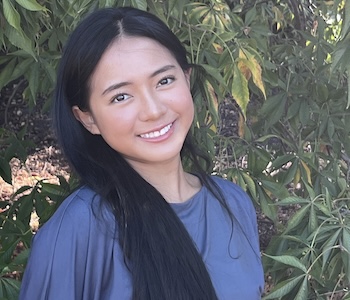
“Talk to your advisor. Don't be afraid, because they help more than you think. Let's say I got a bad grade in class. I would email Forest (Clarke, advisor). I really struggled with self-doubt, so getting reassurance from Forest was really helpful. They were amazing.
“Don't be afraid to change the way you study. During my first two years of college I spent longer than I should have trying to study the way I did in high school, and I eventually realized that it wasn’t working. I tried different methods. I reread the notes. I rewrote my notes. But then I tried active recall, where I just talk out loud and try to reteach a concept. It helps me find gaps in my understanding of a topic. It’s talking and writing at the same time. You're using all your senses.”
Memorable Course
Food, Clothing, Shelter: The Culture and Politics of Simple Living
“We talked about poverty, sustainability, consumerism, housing access and inequality through readings, documentaries, discussions and reflections. I liked how it constantly asked us to think about our own perspectives and how the world shapes people's lives. It reminded me that health is shaped by more than medicine. Societal, environmental and cultural factors affect people's health, which is really important nowadays, with all the gaps that we have in our society. There were a lot of days where I left that class thinking about all the discussions.
"The professor for that class, Daniel Philippon, made it really engaging and was truly curious about his students. You can see his passion for the subject and that he practices what he teaches. It's inspiring to learn from a professor that's leading by his own example.”
Mia Boos is a writer and content strategist with the College of Continuing and Professional Studies, covering the College’s graduate programs and undergraduate individualized degree programs. She joined the CCAPS Marketing team in 2014 and has worked for Thomson Reuters and New York University. Connect with her via LinkedIn.
Request Program Information
Health and Wellbeing Sciences Bachelor's Degree
Do you want to receive:
- snapshots of how other students put their education to work on the job?
- ideas about how to fund your program?
- career-boosting tips and inspiration?
- stories about key faculty?
- highlights on core courses?
- generally interesting news about the program?
You can sign up for periodic updates here and we'll deliver these and more right to your inbox.