
Apply By
Rolling DeadlinesAdmission GPA
3.0+Total Credits
30Format
Fully onlineRelated Credentials
-
Cost
$936 per credit
Why Earn a Degree in Sexual Health?
Good sexual health is a necessary part of our overall health. And everyone deserves to have access to clinicians, counselors, therapists, and educators who have expertise in human sexuality. The University of Minnesota is committed to providing integrated, patient-centered care across Minnesota, ensuring that every individual has access to comprehensive healthcare services.
You can become one of those experts with a master’s degree in sexual health. The more healthcare providers and professionals like you who have up-to-date knowledge, the healthier—and happier—your clients can become.
The University of Minnesota’s fully online sexual health master’s program is:
- Authoritative. It was developed in partnership with the Eli Coleman Institute for Sexual and Gender Health in the University of Minnesota Medical School.
- Stackable. You can earn three career-advancing credentials: two stackable graduate certificates and one master's degree.
- Flexible. Our online program does not require residency and is ideal for working adults with busy schedules.
- Relevant. Coursework counts toward American Association of Sex Educators, Counselors, and Therapists (AASECT) certification.
- Welcoming. CCAPS is one of the most diverse and inclusive colleges on campus.
Why the Study of Sexual Health Is So Important
Which Program Is Right for Me?
Are you wondering if you should apply for the Sexual Health degree or one of our graduate-level certificates? Here is a convenient table to help you.
| Degree Components | MPS in Sexual Health | Human Sexuality, Advanced Sexual Health Education, and Transgender Health certificates | Sex Therapy Certificate |
|---|---|---|---|
| Licensure requirement | No additional licensure needed | No additional licensure needed | Meant to be paired with licensure (LPCC, LP, LICSW, etc.) |
| Audience | Aspiring and current sex educators, advocates, practitioners, allied health professionals | Aspiring and current sex educators, advocates, practitioners, allied health professionals | Health practitioners, especially therapists, counselors, and social workers |
| AASECT certification* | May fulfill AASECT CKAs or Training requirements. See individual degree page for details. | May fulfill AASECT CKAs or Training requirements. See individual certificate pages for details. | May fulfill AASECT CKAs or Training requirements. See individual certificate page for details. |
| Federal financial aid eligibility | Yes | No | No |
| Credits | 30 | 12 | 12 |
| Average time to complete (full time/part time) | 2 years/4 years | 1 year/2 years | 1 year/2 years |
* Please note: Financial aid will only apply to standard program costs (tuition and associated student fees, etc.). Students pursuing AASECT certification beyond the coursework offered in the program should plan to finance additional AASECT requirements on their own.
Still not sure?
CCAPS offers a range of graduate programs for students interested in furthering their career in the mental or sexual health space. Compare all of our related degrees and certificates to find the one that works for you.
Stack Your Credentials
Our master's degree in sexuality is unique—it combines three credentials in one: two certificates and a master's degree, all available online. You can choose to pursue just the master's degree or earn all three credentials. To complete all three, you'll need to apply to each program separately. Watch the video to learn more.
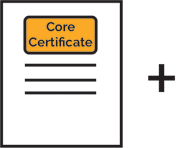
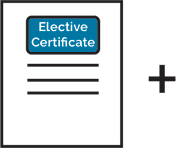
Sex Therapy Certificate OR Adv. Sexual Health Education Certificate OR Transgender and Gender-Diverse Health Certificate OR a Self-designed Track

Six Elective Credits

Master of Professional Studies in Sexual Health
Courses
This degree consists of two stackable graduate-level certificates and six credits of elective coursework that serve to support your professional interests. You can choose to earn the individual certificates and the master’s degree or just the master's degree. In order to earn all three credentials, you must apply to each program.
Students choose one of the following tracks:
Track A – 12 cr
Sex Therapy (certificate available)
Prospective students must have a relevant clinical license or be pursuing a clinical counseling master's degree at the University of Minnesota or another university.
- HSEX 6211 – Dimensions of Sexual Functioning
- HSEX 6212 – Sex and Relationship Therapy
- HSEX 6213 – Sexual Trauma and Trauma-Informed Care
- HSEX 6311 – Health Care for Transgender and Gender-Diverse Adults
Track B – 12 cr
Transgender and Gender-Diverse Health (certificate available)
- HSEX 6311 – Health Care for Transgender and Gender-Diverse Adults
- HSEX 6312 – Intersectional and Decolonizing Approaches to Transgender Health
- HSEX 6313 – Gender Diversity, Sexuality, and Sexual Health
- HSEX 6314 – Considerations in the Care of Transgender and Gender-Diverse Children and Adolescents
Track C – 12 cr
Advanced Sexual Health Education (certificate available)
Required Courses
- HSEX 6013 – Perspectives and Practices in Sexual Health Education
- HSEX 6017 – Design, Implementation, and Evaluation of Sexuality Education
For their remaining 6 credits, students should choose two courses from the following options:
- HSEX 6016 Compulsive Sexual Behavior
- HSEX 6213 Sexual Trauma & Trauma-Informed Care
- HSEX 6312 Intersectional and Decolonizing Approaches to Transgender Health
- HSEX 6313 Gender Diversity, Sexuality, & Sexual Health
- HSEX 6950 Study Abroad: Sex Education in Amsterdam
- HSEX 6994 Directed Research
- HSEX 6905 Sexual Health Education Practicum and Supervision*
* HSEX 6905 is an extended term, fall and spring course that requires application and approval, among other stipulations.
Track D – 12 cr
Self-Designed Track: A personalized selection of courses from available HSEX offerings focused on professional goals
Elective Courses – 6 cr
Students choose six credits of elective coursework in consultation with their advisor and the Director of Graduate Studies.
Total: 30 credits
AASECT Certification
Each HSex course is approved by the American Association of Sexuality Educators, Counselors and Therapists (AASECT) for 35 CE credits. These CE credits may be applied toward AASECT certification and renewal of certification.
The MPS in Sexual Health can fulfill up to 75 hours of Core Knowledge Areas. However, completion of this program does not ensure or guarantee AASECT certification. For further information on AASECT certification, please contact [email protected].
Please note that financial aid will only apply to standard program costs (tuition and associated student fees, etc.). Students pursuing AASECT certification beyond the coursework offered in the program should plan to finance additional AASECT requirements on their own.


Faculty and Staff
CCAPS is invested in your success and well-being. From your academic advisor to the Director of Graduate Studies, we are here to help you navigate an educational and career path that works for you.
In addition, the Sexual Health program is guided by skilled instructors, advisors, and professionals in the fields of sexuality and gender research, therapy, education and policy.
Admissions Advising

Meet Shanta Bhoelai
Shanta Bhoelai can help you choose which graduate program is the best fit for you, answer your questions about specific programs, and support you through the application process. Get to know Shanta in this short profile.
Apply
Admission Requirements
We strive to be fair in the admissions process. Our program thrives when we have students from different backgrounds and cultural experiences. The admissions committee completes a holistic review of all required application materials to ensure that you will be successful in the program. We do not require standardized test scores from the Graduate Record Exam (GRE).
We welcome applications from students who have:
- a bachelor's degree from an accredited post-secondary US institution or its international equivalent
- an undergraduate grade point average (GPA) of 3.00*
- a commitment to the field of sexual and gender health through previous education or experience
- a relevant clinical license or are pursuing a clinical counseling master's degree at the University of Minnesota or another university (Sex Therapy track only)
* If you have a GPA lower than 3.00, please provide an explanation in the extenuating circumstances part of your professional statement.
Important Note
If you have finished or are currently admitted to one or more of the sexual and gender health certificates, please contact your academic advisor. It may be possible to reuse some of your application materials. If you have any questions about admission requirements or materials, please email [email protected].
UMN Undergraduates
If you are a current University of Minnesota student earning your first bachelor’s degree, you can earn up to 6 additional credits to apply toward the MPS in Sexual Health. Find out more about eligibility and courses.
Application Fee Waiver
CCAPS offers a limited number of application fee waivers for the MPS in Sexual Health to US citizens/permanent residents. Please read the application instructions for details on how to apply.
Frequently Asked Questions
We want to provide answers to your questions about the MPS in Sexual Health specifically, as well as our sexual and gender health programs in general.
Request Program Information
Do you want to receive:
- snapshots of how other students put their education to work on the job?
- ideas about how to fund your program?
- career-boosting tips and inspiration?
- stories about key faculty?
- highlights on core courses?
- generally interesting news about the program?
You can sign up for periodic updates here and we'll deliver these and more right to your inbox.