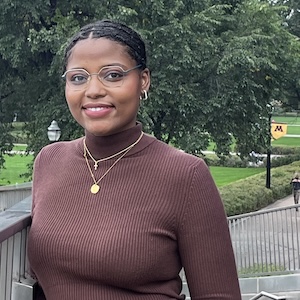
Update: Linh is currently a Quality Engineer II in the New Product Development and New Product Introductions unit of Forj Medical.
Linh Luong has been fascinated by the molecular world and how our bodies work since she was little. Her curiosity deepened in high school, as she began to explore how the brain processes information and stimuli.
In college, Linh majored in neuroscience with a minor in archaeology and anthropology. After she graduated, she worked as a behavioral therapist at an outpatient clinic for children with autism.
”I wanted to open as many doors as possible,” she says, but her plans soon hit an unexpected snag. During the time between submitting applications for graduate programs and decision time, she was diagnosed with epilepsy.
Charting Her Own Course

Linh not only had to decide what discipline to focus on in graduate school, she now had to choose ”what was the most feasible path” for her academically and professionally. She knew the experience would be challenging, no matter what she decided.
But she didn’t allow her diagnosis to limit her options. She chose the Master of Biological Sciences (MBS) program because it is customizable and can prepare students for a wide range of careers. “I saw that you can be in the biomed industry, like pharmaceuticals or medical devices, or use it as experience to make your resume stronger for medical school or get into projects that would propel you into a PhD program.”
With the help of her MBS advisor, Sarah Jaumann, Linh found classes in biomedical engineering and neuroscience. “I still had no idea what I wanted to do,” she says, “but I absolutely fell in love with the first biomedical engineering class I took, which was tissue engineering.”
In fact, Linh continues, Sarah encouraged her to explore a variety of subject areas. “She really advocated for me to take the classes that intrigued me, even if I couldn't get into them (at first),” Linh says. “I loved that about Sarah … I wouldn't be where I am and have the career outlook I have without her.”
Building Experience and Specialization
In her first semester, Linh got a part-time job in a medical device company and worked in a neuroscience lab on campus that studied epilepsy.
“The research I was doing at the U was about seizure control. We were looking at where all the brain activities happen during a seizure in the morning and at night. The long-term goal is to find what region in the cerebellum is best for seizure control. And that really pushed me toward medical devices that help people.”
During her final semester, Linh took a job at Boston Scientific, where she worked on one of their new medical devices. Her role combined two subjects she was passionate about: biocompatibility and tissue engineering.
“It really threw me into how a medical device gets past the development phase and into the market, and I absolutely loved that,” she says. ”I wore a lot of hats in product development, quality, and manufacturing. Out of all of those niches, I loved quality.”
Today, Linh is a supplier quality engineer at TE Connectivity, where she ensures the quality of the materials and components used in their medical device division. She loves engaging with suppliers and helping her company improve devices before they hit the production floor.
Pushing Onward

But getting to this stage in her career wasn’t easy. Managing her disease was a dance of forward and backward steps, progress and setbacks. “I thought, having a neuroscience background, you just throw medicine at it, and it will be fine,” she says.
Linh experiences two kinds of seizures associated with epilepsy, the general tonic-clonic ones, where she may lose consciousness, and the focal absence seizures, where she remains conscious and is aware of what's happening. The former type is now fully under control, but the latter type was about 70% controlled throughout her degree program.
“It hindered me a lot,” she says, “especially having a part-time job, doing lab work, and being a part-time student.”
She cut back on the amount of hours she worked and began attending classes virtually. Sarah, her advisor, also encouraged her to put her health first. “In hindsight I should have probably taken a year off to figure out my physical health before jumping into a master's program,” Linh says, ”but I was a little crazy, so I was like, I'm not gonna wait.”
Linh pressed on and completed her master’s degree in just two years.
Staying Curious and Courageous
As an undergraduate neuroscience student, Linh was involved in a blue jay corvid research project. Corvids are a type of bird family that includes crows, ravens, magpies, and jays, among others.
The goal of the research was to see how this bird family processes new information, whether they developed neophobia—fear of new things. The project, out of the University of Cambridge, required Linh to analyze data gathered from her college and then collaborate with zoos and other institutions across the world.
It may sound counterintuitive, Linh explains, but it may be the outlier of a species that doesn’t fear new things that actually survives. During food scarcity, the individual that is unafraid of eating new foods may live longer than an individual that avoids unfamiliar foods.
Linh, much like these curious jays, faced uncertainty but learned how to adapt and take calculated risks. A touch of fearlessness, it turns out, often benefits us humans as well.
Pro Tip for MBS Students
Keep an open mind. You never know what class is going to open your eyes.
Mia Boos is a writer and content strategist with the College of Continuing and Professional Studies, covering the College’s graduate programs and undergraduate individualized degree programs. She joined the CCAPS Marketing team in 2014 and has worked for Thomson Reuters and New York University. Connect with her via LinkedIn.