Science is a lot like cooking, says Master of Biological Sciences (MBS) alumnus Michael Simeon. “There's a certain creativity to it. A biochemistry professor said it’s like you have the recipe, and it's important to know the recipe, but really good science gets done when you can look at the recipe and know how you need to change it to get what you want or what you need.”
What Michael loves about this adaptable process is the opportunity to learn new things and the thrill of achieving solid results. In the academic lab where he works, that curiosity and gratification drive him and his colleagues to new discoveries. “We have to be on the cutting edge of what we know,” he says. “So not only are we constantly reading books about new topics, we’re learning new technology and better techniques.”
“There's also tremendous fulfillment when you set up experiments,” he continues. “There's something nice about finally putting something in a figure — especially in my current lab where we have very long-running studies — and getting good data at the end.”
Securing a New Role in the Lab
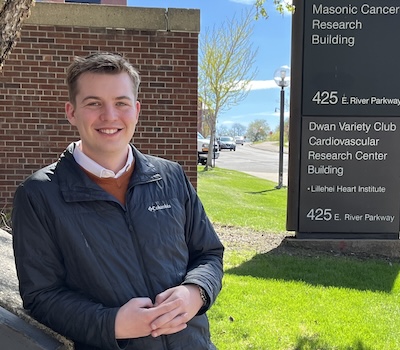
As an undergraduate Michael studied biochemistry and had the opportunity to actively conduct research. He thrived in the environment and essentially had his own project by the time he was a sophomore.
Up to that point he was on a traditional pre-med path, but the day-to-day lab work had an undeniable pull. “Even though it was in a different field than I'm in now, I really enjoyed just doing the science, working on the bench, processing the data,” he says. He realized that his passion lay in investigative science and that at some point he would attend graduate school.
After graduating, Michael got a job at the Mayo Clinic studying interventional radiology and vascular science. He specialized in microsurgery using small animal rodent models. He performed surgical interventions to develop disease models. “I was using microsurgery in order to mimic vascular injury, and that's actually how I got the job (at the University of Minnesota).”
A researcher at the UMN Medical School found his resume and saw that he was trained in microsurgery. Dr. Andrew Adams in the Division of Transplantation, Department of Surgery, needed a rodent microsurgeon to help perform heart transplants in mice. He reached out to Michael and invited him to join his lab.
Fitting a Degree into a Busy Life
This career step aligned perfectly with Michael’s desire to go to graduate school. He knew that working full-time, having a young child and going to classes would be a challenge, so he was drawn to the flexibility of the Master of Biological Sciences program.

“It allowed me to tailor the degree to how I wanted it, while also having the choice of a written thesis versus lab work. Usually you have to do a lab rotation, and I just couldn't really do that with a full-time job.”
He and his wife had a second child while he was still in school, but through a combination of careful planning, remote learning, a supportive spouse and a flexible workplace, Michael completed his degree in just two-and-a-half years. In addition, as an employee of the University, he was also able to take roughly a semester off work for family leave.
With a master’s degree, Michael says he now has the option to pursue roles in different job families or in industry, but he still loves the hands-on research in the lab, work that consistently challenges him to keep learning and seeking good data.
MBS Course Highlights
- Biotechnology and Bioengineering for Biochemists (BIOC 5352)
“Our final project was essentially writing a grant submission for a project we developed, which was really interesting,” Michael says. In his various lab positions, he has contributed to grant proposals, taking care of specific parts or plugging in data. He learned a lot from being on the other side, completing the grant for himself. - Immunity and Immunopathology (MICA 8003)
“Mark Jenkins is one of the most renowned immunologists in the world.” The class was broken up into several different topics, and Dr. Jenkins would bring in experts in that field to present the latest discoveries and techniques that Michael says were incredibly useful to his own research.
Advice for MBS Students
- Take courses that interest you. "That's one of the perks of the MBS program: you're not locked into having to take X. Just focus on the learning part, because that's why you're here. Don't fret too much about GPA."
- Pace yourself. "From a practical point of view, I don't recommend doing two classes a semester. I only did one class a semester outside of one semester."
- Use the advisors. "They can help, and they're incredibly responsive. It can make navigating a kind of tricky process pretty simple. I talked with Sarah (Jaumann) quite a bit, because I'm new to the U. I could ask, hey, I'm interested in these kinds of classes, where do I look for them? And she's able to direct me. So utilize them as a resource, because the entire university catalog can be daunting."
Michael’s capstone paper was titled A persistent threat: the liver graft microenvironment drives T cell residency phenotypes during rejection episodes. To see more MBS research paper topics, visit our website.
Mia Boos is a writer and content strategist with the College of Continuing and Professional Studies, covering the College’s graduate programs and undergraduate individualized degree programs. She joined the CCAPS Marketing team in 2014 and has worked for Thomson Reuters and New York University. Connect with her via LinkedIn.