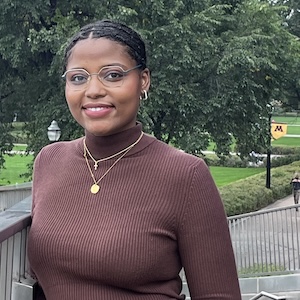
An internship at the Phinizy Center for Water Sciences in Augusta, Georgia, sparked a love of aquatic macroinvertebrates in Elena Schlechte. At the Center’s lab, which is connected to the Phinizy Swamp and a wastewater treatment plant, Elena worked on an ongoing project to track the populations of aquatic macroinvertebrates, like leeches and insect larvae, that live in streams. She also studied the water quality to see if the Center’s efforts to reduce pollution were working.
It was a departure from the orcas and otters she envisioned studying as a kid, when she thought she would become a marine biologist. But her fascination with stream ecology and insect biodiversity ultimately inspired her to pursue a master’s degree in biology.
Putting It All Together
After earning her undergraduate degree, Elena searched for a master’s program that could launch a career in science and give her hands-on research experience. A family member, an alum, suggested she check out the University of Minnesota, where she discovered the Master of Biological Sciences (MBS). The MBS is an individualized program designed for working adults, with options for either coursework-only or a research project.
“I was already working pretty much full-time, and to move from Georgia to Minnesota would require a little bit of part-time schooling, part-time working, and the flexibility really, really appealed to me,” she says.
She made the move up north during the dead of winter and never looked back. Choosing the coursework-only path, Elena focused on aquatics, stream ecology, limnology, and entomology. The customizable nature of the MBS program allowed her to further explore her passion for “aquatic macroinvertebrates and the intersection between ecology and insects.”

Surprisingly, Elena found that the stream ecosystems here can actually be more diverse. “A lot of the predominant properties of stream ecology are about the flow and available substrate of water, and that will change, but it follows really similar patterns in both the South and up here. The main thing I noticed is it just gets too warm in the South to support certain species, like stoneflies and a lot of caddis flies.”
Her graduate studies further deepened her interest in the connections between macroinvertebrates and stream ecosystems, particularly their importance in fostering stream restoration. “They're really important to nutrient cycling in a way that a lot of people don’t necessarily put together,” she says. That insight became the foundation for her capstone paper, Buried macroinvertebrates: how we’re choking our streams.
From Student to Researcher and Teacher
Elena’s exploration of aquatic insects led her to a course on insect neurobiology with Dr. Karen Mesce. One course turned into a seminar and then into an invitation to work in Dr. Mesce’s lab to investigate the neuroscience of leeches. The team is currently studying whether certain parts of the leeches’ nervous system regrow after being damaged.

“And the answer looks to be yes,” Elena says. “These little stretch receptors that help them control their crawling, that go out to the sides of the body, kind of take over after we sever their main connective cord between their ganglia. We see that those stretch receptors start to grow out from the lateral nerves, into the central ganglia, then up towards the other ganglia. It's really wild stuff.”
When she’s not in the lab, Elena brings that same curiosity and enthusiasm to the classroom. She served as a teaching assistant during her time here and is currently an adjunct professor at a community college, where she teaches a variety of courses that include Principles of Biology, Environmental Science, the Human Body, and the Biology of Women.
That experience, Elena says, coupled with guidance and mentorship from fellow TAs and faculty members, directly led to her success as a teacher.
Memorable Courses in Her MBS Program
- Ecosystem Ecology with Dr. Sarah Hobbie: “This course was really fundamental to my understanding of the pieces of an ecosystem.”
- Insect Biodiversity and Evolution with Dr. Robin Thomson: “This course showed me the huge breadth of insects without being so narrowly focused on aquatic macroinvertebrates.”
- Scientific Literature Workshop with Dr. Anke Reinders: “I credit it with further developing my writing talent and understanding of how to do scientific writing and a lot of my success in my capstone project.”
- Stream Ecology with Dr. Ray Newman: “This was also important for establishing those principles of stream ecology.”
Elena's Pro Tip: Start Strong

"In the (MBS) introductory course, we chose a topic to present on. I hadn't started looking at what courses I wanted to take, but I had a general idea. So while putting that presentation together, I kind of had a narrative in my head and followed it through my coursework, and that really prepared me to do the capstone. It was a culmination and synthesis of everything I learned. So my advice would be to try to build that narrative of either your research or your capstone from the start. Go in knowing what you want to do and you'll be able to get the most out of it. But also feel free to explore, because you do have relative flexibility with electives."
Elena is recipient of an Ingrid Lenz Harrison and a CCAPS Larson Legacy scholarship.
Mia Boos is a writer and content strategist with the College of Continuing and Professional Studies, covering the College’s graduate programs and undergraduate individualized degree programs. She joined the CCAPS Marketing team in 2014 and has worked for Thomson Reuters and New York University. Connect with her via LinkedIn.