CCAPS instructors Eugene Hall and Fiyyaz Karim took Integrated Behavioral Health (IBH) master’s students to the Virtual Reality Studio in the Health Sciences Education Center, which is operated by the University Libraries. We spoke to Fiyyaz and the VR studio’s Charlie Heinz, as well as four students about the experience: Adys D., Jace H., Matthew C., and Ruby Z.
Going Beyond What-Ifs
What if mental health professionals could practice interacting with a client in a low-risk, realistic setting? What if they could put themselves in their clients' shoes and experience sensations similar to what they’re feeling? With evolving virtual reality (VR) technology available right here on campus, they can.
Choosing the Right Tool
Virtual reality and its applications to the mental health field aren’t new, but the sophistication and capabilities of technology are growing rapidly. Finding the platform that is appropriate for the participants and aligns with your goals is the first step. But where do you even start?
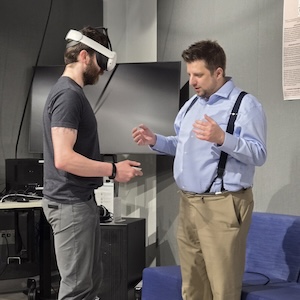
Instructors Eugene Hall and Fiyyaz Karim worked with Charlie Heinz, academic technologist and VR program lead, to match their class objectives with the best VR options.
Part of Charlie’s role at the studio is to aid instructors who want to incorporate virtual reality into their curriculum. He develops assignments, assesses learning outcomes, and determines how to connect them to a virtual reality activity. The studio provides the space, equipment, and technical expertise.
Eugene and Fiyyaz’s goals for students in the class Trauma and Crisis Intervention were simple: familiarize them with the tools that they could potentially use with future clients—specifically in exposure therapy and cognitive behavioral therapy (CBT)—and practice their communication skills. They met with different vendors and explored the collection of resources the VR studio already owned.
In the end, they landed on PsyTechVR, a platform that specializes in exposure therapy with CBT and EMDR (eye movement desensitization reprocessing) protocols. It can create simulations of phobias like arachnophobia, fear of flying, or fear of heights.
Setting Up Scenarios

When the graduate students first came into the studio, Charlie explained the basics, like wearing a VR headset over glasses, the interface, and what to do if you become nauseous.
The next thing they did was create their own safe space, just as their patients would do during an exposure therapy session. (This type of therapy “exposes” individuals to the objects, activities, or situations that they fear in a safe environment.) The students entered a short description of a setting that would provide comfort, like a beach or a room full of puppies, and the app generated a space for them, complete with background music.
“The idea is that when you go and experience 10 seconds of flying, you can always retreat back to that safe space,” Charlie says.
“I love how VR is able to simulate different phobia scenarios with (an) adjustable level of intensity,” adds student Ruibing (Ruby) Z.
Another student, Adys D., agrees: “The extent to which you can customize is fantastic. They create such a realistic experience that it's easy for the client to get absorbed. Increased patient engagement often translates to more effective healing.”
Science Fiction or Groundbreaking Resource?
Participants also had time to explore a mental health practitioner scenario using Bodyswaps, an immersive AI platform. Bodyswaps allows the user to interact with an avatar to practice active listening, navigating conversations, or in the case of the mental health practitioner, talking to someone who has had suicidal ideation.
In that instance, after hearing what the patient avatar has to say, the user is prompted to give their reaction or response. Then the app flips, with the user now sitting on the couch where the patient is and able to see and hear the avatar speaking with their voice. Users can see their body language and head position, and hear the tone of their voice, pacing, and word choice.
Student Matthew C. said that the platform “allows for an experience that can be shared with a counselor … This can lead to difficult moments, such as a natural disaster or interpersonal violence, becoming a shared event. Being able to share as much in that event as possible to have a frame of reference … is a key that VR has solidified for me.”
“It can also measure whether you used phrases that the patient used,” Charlie says. “So if you're trying to show that you're listening, you can repeat something they said.”
There is an element of gamification as well. Bodyswaps scores users at the end of the session and provides feedback, like the pacing was excellent but the body language was closed and no repeated phrases were said. The user could then return to the scenario and try to improve their score.
Overall, says instructor Fiyyaz Karim, “students were able to practice essential clinical skills within lifelike, interactive environments—an experience that powerfully demonstrated how VR can revolutionize trauma-focused therapy.”
Possibilities and Questions Ahead
While the possibilities of VR in therapy are promising, this is a quickly evolving field and challenges may arise. Matthew thinks that its uses in exposure therapy are apparent but that the current apps may be best used for teaching breath work and creating shared environments.
In addition, there are questions around insurance coverage and billing. Adys notes that the cost of VR equipment and the training required for both therapists and clients could be prohibitive.

Jace H. hopes that using VR “as a more versatile tool for education, occupational services, and training … is expanded as the technology improves and becomes more commercially available.”
Nonetheless, it is a unique benefit for students and faculty at the University of Minnesota. Adys says that “having such a facility on campus not only enriches academic programs but also positions the institution as a leader in the integration of technology with mental health care.”
Ruby believes that VR could be an excellent supplemental learning tool for new counselors outside of the classroom. It can “fill the gap between theory and real practice” by providing users with lifelike, practical conversations.
“With any technology as complex as VR,” Jace notes, “there is an inherent learning curve. It will be important … that we educate ourselves and our clients on how to best use the technology in an effective manner. If VR is proven to be effective, it would be a disservice to clients who it would help to not allow them to use this technology.”
The hands-on experience, Fiyyaz concludes, showcased the potential benefits of therapeutic simulations and enhanced patient engagement strategies. It allowed the students to experiment with new tools that address trauma in safe, controlled, and innovative ways. These tools can help counselors understand complex psychological concepts—even if they don’t actually bring the devices into their therapy sessions.
“Staying open-minded about treatment modalities allows us to maximize our creativity to help people,” says Matthew.
More about Charlie and the VR Studio
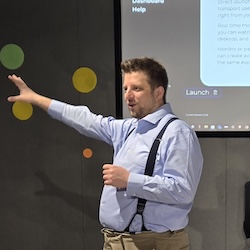
Charlie Heinz has been with the Libraries for about 18 years in various roles. He has served as virtual reality program lead since the studio’s inception in 2021 and has worked with many classes across disciplines, from health sciences to design and journalism.
The studio is available to all University of Minnesota colleges and professional schools, free of charge. Sessions in the studio can run 90 minutes to three hours, depending on desired outcomes. Charlie can work with users from the beginning of the process to the end, depending on their comfort level with the technology. The studio also has headsets that people can borrow to use at home.
All photos courtesy of Fiyyaz Karim.
Mia Boos is a writer and content strategist with the College of Continuing and Professional Studies, covering the College’s graduate programs and undergraduate individualized degree programs. She joined the CCAPS Marketing team in 2014 and has worked for Thomson Reuters and New York University. Connect with her via LinkedIn.