Each year, as winter grips the North Star State, students and faculty from across University of Minnesota campuses and academic disciplines trade snow for sunshine and travel to San Ramón, Costa Rica. Located in the Alajuela province, San Ramón is an agricultural town of approximately 10,000 residents, with an economy rooted in coffee, sugarcane, ornamental plants and cattle farming in the surrounding rural areas.
Their destination is part of the College of Continuing and Professional Studies' Pura Vida Learning Abroad program — an annual journey launched in 2014 by program director Peter Hilger with the encouragement of Construction Management alumnus Dustin Dresser '08, who now lives in San Ramón.

What began as an idea rooted in global engagement has grown into a collaborative, hands-on learning experience that thrives on interdisciplinary thinking. At its core, the program blends experiential learning with cultural immersion through community-based projects that change focus each year.
"The Pura Vida Learning Abroad experience was the perfect blend of cultural immersion, adventure, and learning. Nothing can replace doing the work you're passionate about alongside students from different backgrounds with shared goals," says participant Elijah Gavin.
To date, 132 students have partnered with local organizations to develop proposals for initiatives as diverse as a medical clinic and senior citizens home, a men's shelter, a women's cancer recovery center and a disability services provider.
In some cases, the students' work leads to lasting change. One such proposal, the expansion of a local orphanage, was ultimately funded and built, creating a tangible and enduring community impact.
Through it all, one phrase guides the experience: pura vida ("pure life" or "the good life"), a defining expression of Costa Rican values that continues to inspire participants long after they return to Minnesota.
Immersed in Culture, Growing as a Team
In January, 15 students and three faculty members arrived in Costa Rica ready to turn learning into action, contributing their skills and talents to a project for Residencia para Personas Adultas Mayores de San Ramón (San Ramón Home for Older Adults).
But first, a bit of acclimation and team-bonding were in order, including white-water rafting on the Rio Balsa, lunch hosted by program friend Magdalena on her farm, and a tour of the Bajo Tejares neighborhood of San Ramón and the Residencia project site.

Balanced with their work, the group’s cultural immersion activities continued throughout their two-week stay. Students visited a trapiche, where they participated in the sugarcane milling process; a coffee plantation, where they harvested coffee berries and learned about artisanal coffee processing; and MUSADE, where they learned about the center’s advocacy for battered women and its private medical clinic.
On the weekend, they traveled to the Central Pacific coast to take in the diverse wildlife (capuchin monkeys, iguanas, scarlet macaws!), pristine beaches and rainforests of renowned Manuel Antonio National Park.
They learned salsa dancing, visited the local farmer’s market, where sampling tropical fruit crowned a mango–pineapple variety the group favorite, and shared breakfasts of gallo pinto (rice and beans).
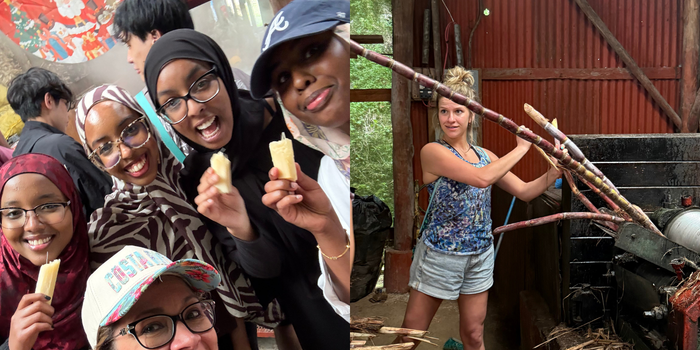
Taken together, these experiences grounded the group in Costa Rican culture, helped them connect with one another and energized their ongoing work at the Residencia para Personas Adultas Mayores.
"I've learned that stepping outside of my comfort zone leads to some of the most meaningful growth. During my two-week stay I experienced the culture through local food, traditions and the language, which helped me better understand life in Costa Rica," shares participant Yusra Dini. "Overall, this experience helped me grow personally, become more open-minded and see things from new perspectives."
The Need, The Team, The Challenge
"Working as a consulting team, students work within their disciplinary area of expertise to find solutions to particular problems, identify opportunities for new programs and services, or develop creative ideas through client and stakeholder engagement," says Hilger. "Proposals are submitted in Spanish and colones (the local currency), and use the metric system, so the final report can be shared with the organization's board or state agencies that could fund development grants."
This year, students tackled a project to safeguard resident and staff well-being while maintaining operations during Residencia’s roof replacement. With the facility remaining open, the team addressed challenges before, during and after construction, drawing on their expertise as students in fields related to construction, information technology (IT) and healthcare management:
- The Construction team focused on relocating facility zones, minimizing disruption, maintaining safety and proposing solutions for flooding in main corridors.
- The IT team created strategies to prevent technological disruptions, manage office and system relocations, and support long-term operational efficiency.
- The Healthcare Management team prioritized resident and staff safety, continuity of meals and care, and nursing ward relocation while developing strategies to reduce isolation and foster engagement. Two students, one studying nutrition and the other occupational therapy, were also able to shadow Residencia staff to learn about local practices.
Working together, all three teams integrated their findings into a coordinated proposal with practical, actionable recommendations aligned with Hogar’s mission, vision, and values.
"I had developed several assumptions about how things should work in healthcare that did not translate into actionable insights in Costa Rica," shares Elijah. "Faced with unfamiliar regulatory, financial and social dynamics, our group began to make breakthroughs as soon as we abandoned an attitude of expertise for one of curiosity and humility."
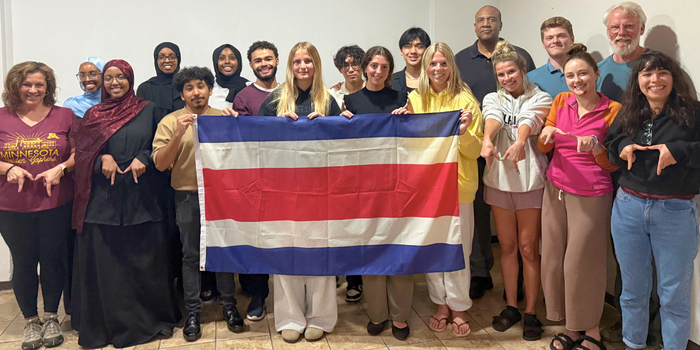
Drawing on their construction, IT, and healthcare management expertise, all three teams created a coordinated, practical proposal. Before returning to Minnesota, they presented their recommendations to the Residencia para Personas Adultas Mayores’ administration and were inspired by the residents' engagement, seeing firsthand the tangible impact of their cross-disciplinary work.
Photo at top of page, shown left to right — First row: Jakob Black, Ruby Dircks, Rachel Hauer, Bree Ihrke; Second row: Sumaya Hassan, Andy Sanchez, Daniel Vu, Kelly Crocker, Tiffany Hansen, host Grace Ramirez, faculty director Frances Fernández, Elijah Gavin, Yusra Dini, host Julio Ramirez; Third row: Faduma Abdulkadir, faculty director Colin Miller, Saynab Omar, Thomas Kim, program and faculty director Peter Hilger, Joe Gargano
Photos courtesy Frances Fernández
Anastasia Faunce is a writer and content strategist with the College of Continuing and Professional Studies, where she covers pre-college, ESL, long-term care, applied undergraduate degree programs and alumni and development initiatives. A former director of several CCAPS programs, she previously served as director of public relations for the Minneapolis College of Art and Design and continues to collaborate regularly with artists and designers. Connect with her via LinkedIn.