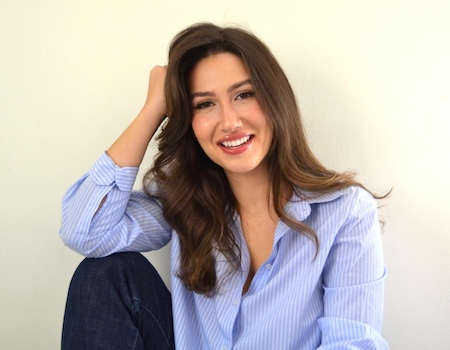
Master of Professional Studies in Sexual Health student Nefeli Ioannidi is a sex educator working in Dubai, United Arab Emirates. She is currently the only online student in the master’s program based in the Middle East. Her work focuses on intimacy, shame, desire, relationships and body image. She is committed to moving people “from confusion, shame or dissatisfaction to confidence, clarity and connection through education, honest conversations and lots of curiosity.” We asked her to answer some questions via email.
What did you study as an undergraduate student?
I have a bachelor’s in Greek philology (which includes lots of Ancient Greek and linguistics), and I majored in Medieval and Modern Greek Literature. I was a bookworm through and through. You could always find me reading or writing somewhere. My younger sister complains to this day that I wouldn‘t go play with her outside cause my face was always buried in a book.
What made you decide to go to graduate school?
I always knew that I’d continue my education. I was planning to do a master’s in social anthropology after I graduated, but I ended up moving to Dubai and life got in the way. I realized after a couple of years of living in the Middle East that topics like sexuality and intimacy were a big taboo, so I became the “Westerner” friend everyone would go to for questions.
At work, even though most of my colleagues were more conservative, I was always encouraging conversations about relationships, dating and the human psyche. I also had strangers message me on Instagram about the morning-after pill or asking me if they can contract an STI from oral. “With great power (in my case, more like reputation) comes great responsibility,” so I decided I needed to deepen my knowledge. I got certified to teach Sex and Relationships Education, and that’s when I knew that I wanted to dive even deeper.
How did you become interested in this field?
My parents were hippies when they were younger, so I grew up with lots of open conversations around sex and sexuality. There was no shame around these topics at all. My mom was the first person I confided in when I had my sexual debut, and I remember she said something like “woo hoo, tell me all about it!” which made me want to curl up in a hole and hide. But in hindsight, it’s a funny story I share with my clients.
This whole approach made me feel very safe and open with my sexuality, and I quickly realized that this is not the case for most people. Most of my friends grew up with silence and shame around these conversations so I took it upon myself to use my knowledge for good. I always say that touching people’s lives in a positive way is as close as I can get to an idea of religion. I have clients who started loving their body after unlearning that virginity is their only virtue as a woman, and others who started enjoying sex and being vocal about their needs, after being in sexless marriages. It’s such a gift to be able to do what I do.
Do you have a focus area in your studies or a specific population you want to work with?
I definitely want to focus more on people who come from conservative backgrounds. Both in my home country of Greece and in the UAE, there is a big gap in sex education and sexual health in general. I always had a soft spot for people who were raised to be ashamed of their sexuality because I have seen the effects of that in all aspects of their lives.
When I started working as a sexual health educator I thought that I wanted to mainly focus on women, since I can relate to them more, but I was surprised to discover that I truly enjoy having male clients. Unpacking patriarchal beliefs and sex myths with men feels so rewarding. Most of the men I see are religious and quite traditional (by Middle Eastern standards), so it’s such a revelation to have them be curious and receptive to new ideas and approaches.
Have there been any instructors or courses that stood out?
I think I was more drawn to the topics that I find more useful for my practice. I really enjoyed learning more about pleasure, sexuality and its different manifestations and relationships. The range of courses was very well built, and I’m so glad classes like Trauma and Trauma Informed Care and CSE (comprehensive sex education) were also included. They gave a more in-depth aspect to the program. If I had to pick my top three, I would probably say Foundations of Human Sexuality, Sex and Relationship Therapy and Sexual Pleasure and Intimacy.
What is it like being a fully online student?
I have to admit I’m not particularly good at managing my schedule, so it’s been hard for me at times. But if you are disciplined and organized, it’s quite manageable, even with a full time job. All the course materials/lectures were asynchronous (aside of a couple exceptions), so it’s up to the student to manage the time allocation. I normally study a few hours every other day in the evening and longer hours during the weekend when I also finish most of the assignments. I know some classmates of mine who had specific days for studying the papers and different ones for the assignments. To each their own!
I think the biggest challenge for me with studying online is the fact that I didn’t have the opportunity to mingle with my classmates, share our thoughts about this or that class and gossip about our own lives. As someone who loves meeting new people, I did miss the interpersonal aspect of student years, even though I did connect with some of my classmates offline. Nevertheless, I’m very grateful for the opportunity to study something I love all the way from the Middle East!
What advice do you have for new sexual health graduate students?
Make sure you’re ready to challenge your own beliefs, learn a bunch of new stuff and start seeing sexual health as so much more than consent, condoms and STIs. Sexual health is a fundamental piece of overall health and well-being. Sex and sexuality are the most intimate parts of people’s lives and, depending on which path you choose to follow professionally, learning how to navigate and hold space for these conversations can have a meaningful, long lasting impact on how people love, relate to others and raise the next generation. At the risk of sounding sentimental, I truly think that choosing to study sexual health is noble and very, very important in a world that rapidly devalues human connection and eroticism.
You can find Nefeli’s writings on Substack at substack.com/@honestlynef or follow her on Instagram at @honestlynef.
Request Program Information
Master of Professional Studies in Sexual Health
Do you want to receive:
- snapshots of how other students put their education to work on the job?
- ideas about how to fund your program?
- career-boosting tips and inspiration?
- stories about key faculty?
- highlights on core courses?
- generally interesting news about the program?
You can sign up for periodic updates here and we'll deliver these and more right to your inbox.